
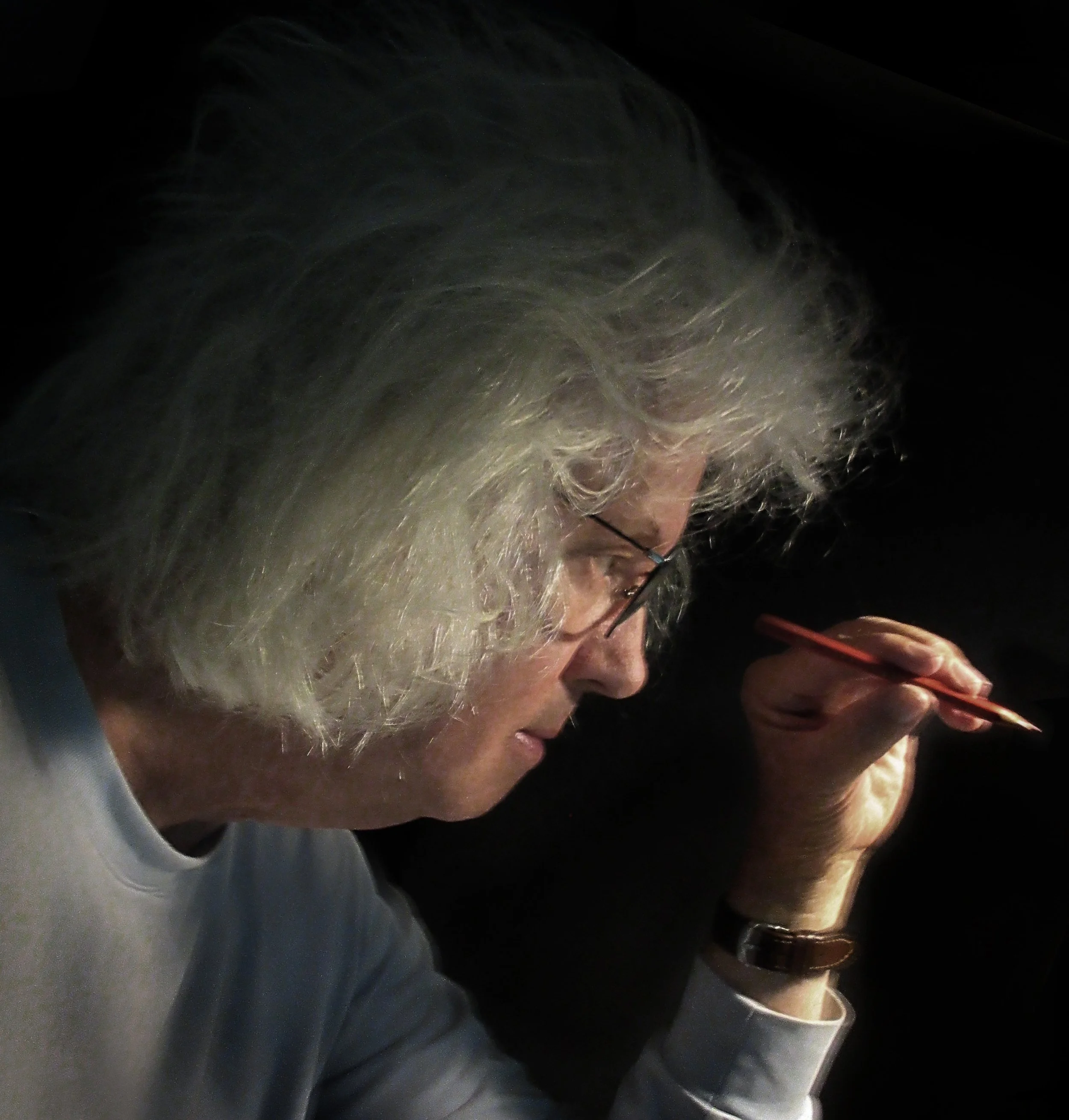
Greg Crossley is an artist whose lifelong drawing practice began in childhood in Alberta, Canada. Fascinated from an early age by the challenge of accurately rendering the world around him, he developed a deep commitment to observation and draftsmanship that has remained central to his work.
After studying art and design in Calgary, Greg began a professional career in visual communication, working in educational television before moving to New York City, where he spent decades in advertising and design. Throughout his career, drawing remained both a personal pursuit and an essential creative tool, informing his approach to visual storytelling and problem-solving.
His exposure to photography, filmmaking, and the controlled use of light profoundly influenced the evolution of his work. Drawing on these experiences, Greg developed a distinctive approach centered on illumination, contrast, and atmosphere. Working only on black paper, he treats darkness as a field of space into which light is carefully introduced, shaped, and controlled.
The resulting drawings explore the relationship between observation and perception, revealing form through the deliberate orchestration of light. While this work represents the public emergence of a practice developed over many decades, it reflects a lifelong dedication to drawing as both craft and artistic expression.
Greg lives and works in New York City and Southwest Harbor Maine.
You can reach him at crossley.greg@gmail.com
Artist Statement
My work is an exploration of light.
I work exclusively with black paper and watercolor pencils. Drawing is my only technique. The simplest tools—a sheet of paper and a pencil—are all I need to realize an idea. Although I use watercolor pencils, I never introduce water because I want complete control over every mark, every transition, and every effect.
My practice is built upon a careful selection of materials. Using only black paper and drawing media chosen for the precision of their pigment, texture, and response to the surface. Every mark is intentional, allowing me complete control over the subtle transitions that create light, form, and atmosphere. I see black paper not as a surface, but as black space—a dark void from which light emerges. This way of working fundamentally changed the way I see the world. After years of drawing on black paper, a blank sheet of white paper no longer feels neutral. It feels as though a bright light is shining directly into my face
Everything I create begins with the interaction between light and darkness. I am fascinated by the way light reveals form, transforms materials, defines texture, and shapes our perception of space. My drawings are not simply representations of objects or figures; they are investigations into the subtle tonal transitions that allow light to emerge from darkness and give the illusion of depth, atmosphere, and presence.
Observation is central to my practice. Every day I study the world around me, paying close attention to the way light falls across surfaces and transforms ordinary materials. I photograph textures, patterns, and moments of illumination that later become part of my drawings. This continual process of observation has trained me to notice the almost imperceptible shifts between brilliance and shadow that most people pass without seeing.
Whether the subject is the human figure, the landscape, or light itself, every body of work is guided by the same pursuit: to understand how light defines our experience of the world. Capturing that fleeting relationship between light and darkness remains the foundation of my practice and the source of my inspiration.